



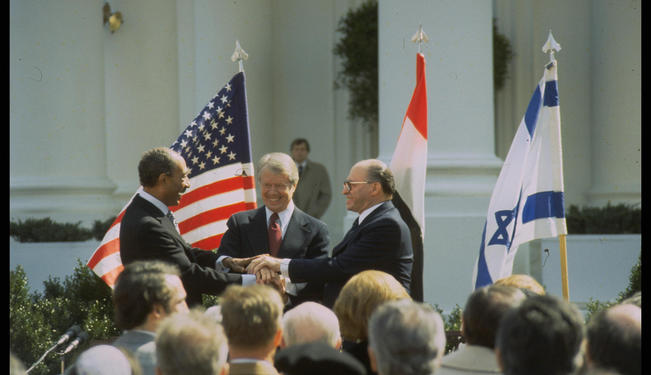
The Middle East peace process refers to ongoing diplomatic efforts to resolve the long-standing conflicts between Israel and its Arab neighbors, particularly the Israeli-Palestinian conflict, as well as broader regional tensions. Key issues include borders, security, Israeli settlements, Palestinian refugees, the status of Jerusalem, and mutual recognition.
Major Components of the Peace Process:
Israeli-Palestinian Conflict
Two-State Solution: A proposed framework where Israel and an independent Palestinian state coexist peacefully.
Oslo Accords (1993–1995): Established limited Palestinian self-rule in parts of the West Bank and Gaza, but did not resolve final-status issues.
Camp David Summit (2000): Failed negotiations between Israel (Ehud Barak) and the PLO (Yasser Arafat).
Arab Peace Initiative (2002): Proposed by Saudi Arabia, offering normalized Arab-Israeli relations in exchange for a Palestinian state.
Recent Efforts: The Abraham Accords (2020) normalized relations between Israel and some Arab states (UAE, Bahrain, Morocco, Sudan), but did not address Palestinian demands.
Israeli-Arab Conflicts
Peace Treaties:
Egypt (1979) – First Arab country to recognize Israel.
Jordan (1994) – Established full diplomatic relations.
Syria & Lebanon: No formal peace; Israel withdrew from southern Lebanon (2000) but disputes (e.g., Shebaa Farms) remain.
Key Challenges
Settlements: Israeli settlements in the West Bank are considered illegal under international law (UN Resolution 2334).
Gaza Strip: Controlled by Hamas since 2007, leading to repeated conflicts (e.g., 2008–09, 2014, 2021, 2023–24).
Jerusalem: Israel claims it as its “undivided capital,” while Palestinians seek East Jerusalem as their future capital.
Refugees: Millions of Palestinian refugees demand a “right of return,” which Israel rejects.
Current Situation (2024)
The October 2023 Hamas-Israel war has stalled peace efforts, with high casualties in Gaza and regional tensions escalating.
The U.S. and EU still advocate for a two-state solution, but trust between Israelis and Palestinians is at a historic low.
Some Arab states (e.g., Saudi Arabia) may still consider normalization with Israel, but demand progress on Palestinian rights.